 ASIC Miner Insider
ASIC Miner vs GPU Mining: Which Maximizes ROI? (2026 Profitability & Flexibility Guide)
Deciding between an ASIC miner vs GPU mining setup determines your profitability in 2026.
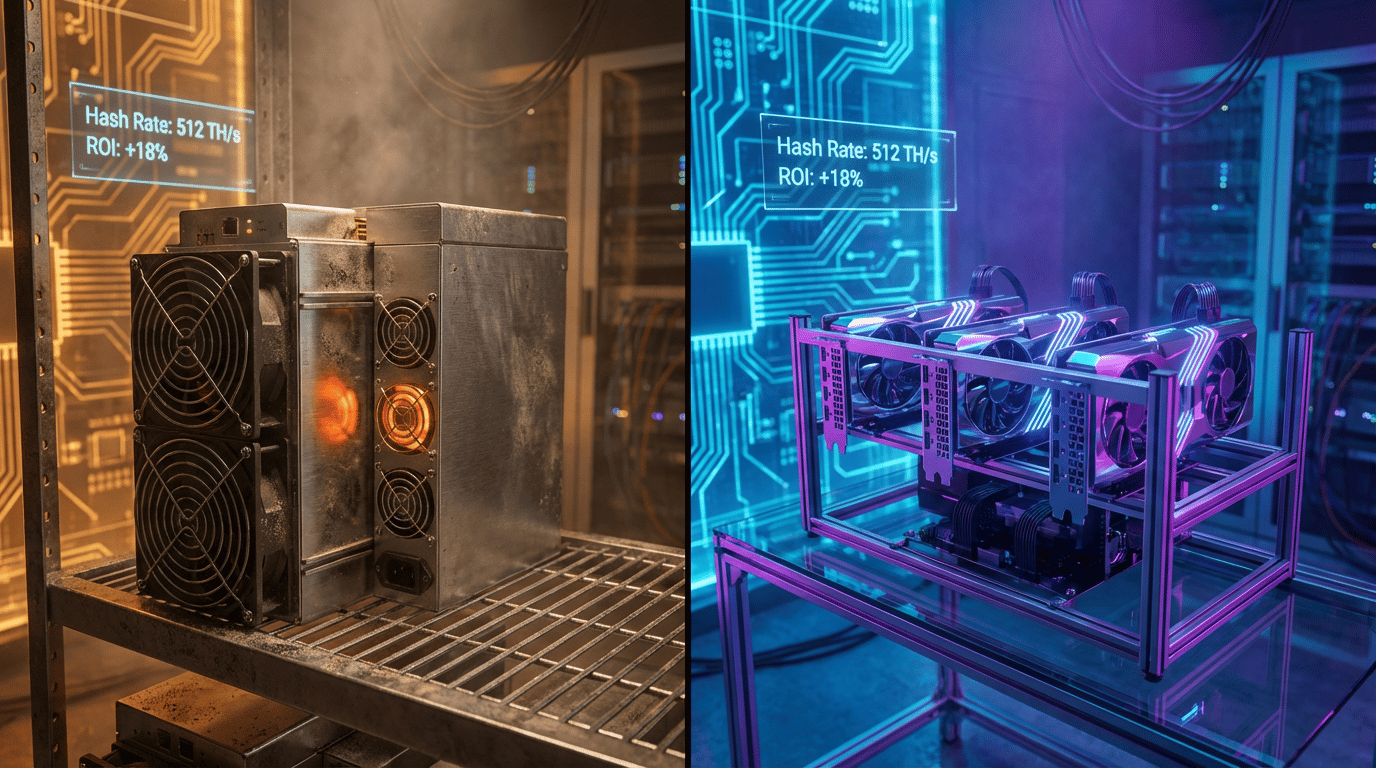
When comparing asic miner vs gpu mining, the choice fundamentally depends on your investment goals and risk tolerance. ASIC miners offer superior hash rate efficiency and power, making them the only viable option for mining major cryptocurrencies like Bitcoin. However, GPU mining provides unmatched versatility, allowing miners to switch between various altcoins or pivot to AI processing, while retaining high hardware resale value. If you want maximum raw output, choose ASICs; if you prefer flexibility and lower long-term risk, GPUs are the better path.
The Situation: Crypto Mining Hardware in 2026
The landscape of crypto mining hardware has evolved dramatically over the last decade. What started as a hobby for tech enthusiasts using bedroom laptops has transformed into a competitive industry. By 2026, the market has matured into two distinct camps. On one side, we have industrial-grade operations maximizing every watt of electricity. On the other, we have decentralized home miners looking for passive income streams. While the days of easy, low-difficulty mining are behind us, the opportunity to generate profit remains for those who understand the technology. The core of this opportunity lies in selecting the right tool for the job.
The Conflict: Hash Rate Efficiency vs. Versatility
Here lies the central conflict for any prospective miner: the trade-off between specialization and flexibility. You want to maximize your Return on Investment (ROI), but you also want to protect your capital.
An ASIC (Application-Specific Integrated Circuit) is like a Formula 1 car. It is engineered to do one thing perfectly: race around a specific track. In crypto terms, it solves one specific algorithm (like SHA-256 for Bitcoin) with incredible speed. However, it cannot drive on any other road. If the algorithm changes or the coin's value plummets, the hardware becomes an expensive paperweight.
Conversely, a GPU (Graphics Processing Unit) is like a rugged SUV. It isn't as fast as the F1 car, but it can drive off-road, on highways, and through the city. A GPU rig can mine dozens of different coins, render 3D video, or even run AI computations. The conflict is simple: do you bet everything on speed (ASIC) or utility (GPU)?
The Question: How Do You Calculate Mining Viability?
Before buying hardware, you must ask yourself three critical questions regarding asic miner vs gpu mining:
- What is your electricity rate? Mining turns electricity into digital assets. If your power costs are high (over $0.12/kWh), efficiency becomes your only metric.
- What is your exit strategy? Are you planning to mine for 3 years and sell the equipment?
- Where will the rig live? ASICs are notoriously loud and hot, while GPUs are easier to manage in a residential setting.
The Answer: Detailed Breakdown of Performance and ROI
To solve the puzzle of asic miner vs gpu mining, we must look at the technical distinctives of each hardware type in the current 2026 market.
The Case for ASIC Miners: Specialized Power
ASIC miners are the heavyweights of the industry. These machines are purpose-built chips designed solely to mine cryptocurrency. Because they strip away all non-essential computing functions, they achieve hash rate efficiency that GPUs simply cannot match.
For Bitcoin, Litecoin, or Kaspa, ASICs are mandatory. A modern GPU would take thousands of years to find a block that an ASIC can find in minutes. The primary benefit here is density. A single ASIC unit can produce the hashing power of a room full of GPUs. However, the downside is the "lock-in" risk. You are married to that specific coin's algorithm. Furthermore, electricity costs in mining with ASICs can be substantial, requiring dedicated 220v circuits and active cooling solutions.
The Case for GPU Mining: Flexibility and Resale
GPU mining involves building a computer with multiple high-end graphics cards (like NVIDIA or AMD series). While they lack the raw power of ASICs for Bitcoin, they excel at mining memory-hard algorithms used by many altcoins.
In 2026, the biggest advantage of GPUs is their secondary market value. If crypto mining becomes unprofitable during a bear market, you can repurpose your cards for high-demand sectors like gaming, video rendering, or the booming decentralized AI compute market. This dramatically lowers your investment risk. A 3-year-old ASIC might be scrap metal, but a 3-year-old high-end GPU still holds significant cash value.
Side-by-Side Comparison: ASIC vs. GPU (2026 Data)
To help you visualize the differences, here is a comparison based on current market conditions:
| Feature | ASIC Miner | GPU Mining Rig |
|---|---|---|
| Primary Use Case | Bitcoin & major established coins. | Altcoins, new projects, AI compute. |
| Hash Rate Efficiency | Extremely High (Specialized). | Moderate (General Purpose). |
| Flexibility | Low (Locked to one algorithm). | High (Switch coins or tasks instantly). |
| Resale Value | Low (Depreciates fast as difficulty rises). | High (Valuable to gamers/AI labs). |
| Noise & Heat | Very High (Industrial fans required). | Moderate (Can be quieted with tuning). |
| Setup Difficulty | Plug-and-play (Easier setup). | Complex (Requires PC building skills). |
| ROI Timeline | Faster (in bull markets). | Slower, but more consistent/safer. |
Managing Electricity Costs and Durability
Profitability is the revenue from coins minus the cost of power. ASICs are generally more power-hungry but offer a better "hashes per watt" ratio. If you have access to cheap industrial power or solar, ASICs maximize that advantage. GPUs draw less total power but are less efficient at converting that power into hashes. However, GPUs are generally more durable. An ASIC runs at 100% capacity 24/7 and often burns out after 2-3 years. A well-tuned GPU running at 70% power can last 5+ years with simple fan replacements.
Buyer Scenarios: Which is Right for You?
Based on the analysis of asic miner vs gpu mining, here are our recommendations for different types of users in 2026.
Scenario A: The "Home Hobbyist"
You have a spare room or basement and pay standard residential electricity rates. You are interested in crypto but don't want to rewire your house.
Verdict: Choose GPU Mining.
Why? It is quieter, produces manageable heat, and if you get bored, you have a killer gaming PC or parts you can easily sell on eBay.
Scenario B: The "Profit Maximizer"
You have a garage, shed, or warehouse space. You have upgraded your electrical panel or have cheap electricity rates. You are bullish on Bitcoin.
Verdict: Choose ASIC Miners.
Why? You are playing for high stakes. The noise doesn't bother you, and you want the maximum possible extraction of value from the network. You accept the risk that the hardware value might go to zero in exchange for higher monthly cash flow.
Scenario C: The "Diversified Investor"
You want exposure to new, smaller coins that haven't exploded in value yet. You like tinkering with software.
Verdict: Choose GPU Mining.
Why? ASICs can't mine new experimental coins. GPUs allow you to be an early adopter on new blockchain networks, potentially mining millions of tokens before they become valuable.
Final Verdict: Balancing Risk and Reward
In the debate of asic miner vs gpu mining, there is no single winner—only the right tool for your specific strategy. ASICs represent the industrialization of crypto: efficient, powerful, and singular in purpose. GPUs represent the democratization of crypto: flexible, resilient, and accessible. If your goal is to accumulate Bitcoin directly and you have the infrastructure, buy an ASIC. If you want a lower-risk entry point with multiple exit strategies, build a GPU rig. By understanding mining rig resale value and operational costs, you can turn either choice into a profitable venture in the 2026 digital economy.
FAQs
What is the fundamental difference between ASIC and GPU mining?
ASIC miners are specialized machines designed to do one thing perfectly (like mining Bitcoin), offering high speed but low flexibility. GPU mining uses graphics cards that are less efficient in raw power but offer high versatility, allowing users to switch between altcoins, AI processing, or gaming.
How do resale value and investment risk compare between the two?
GPUs have high resale value and lower risk because they can be sold to gamers or AI labs if mining becomes unprofitable. ASICs have high risk; if the specific coin's value drops or the algorithm changes, the hardware often becomes worthless scrap metal.
What factors should I consider before purchasing mining hardware?
You need to evaluate three critical areas:
- Electricity Cost: If paying over $0.12/kWh, efficiency is critical (favoring ASICs).
- Location: ASICs are loud and hot (industrial space), while GPUs are manageable at home.
- Exit Strategy: Whether you plan to resell the hardware later (favoring GPUs).
Which hardware is better for home environments?
GPU mining is the better choice for residential settings. It produces manageable heat, runs quieter, and is easier to resell. ASICs are generally too loud and generate too much heat for a spare room or basement without significant infrastructure modification.
What is the expected lifespan of ASIC miners versus GPUs?
GPUs are generally more durable, with a lifespan of 5+ years when tuned correctly. ASICs typically run at 100% capacity 24/7 and often burn out or become obsolete within 2 to 3 years.