 ASIC Miner Insider
Antminer S21 vs Whatsminer M60S: Maximizing Bitcoin Mining ROI with Superior Efficiency and Stability
Comparing the Antminer S21 vs Whatsminer M60S reveals a distinct choice between raw efficiency and rugged durability. The S21 leads with 17.
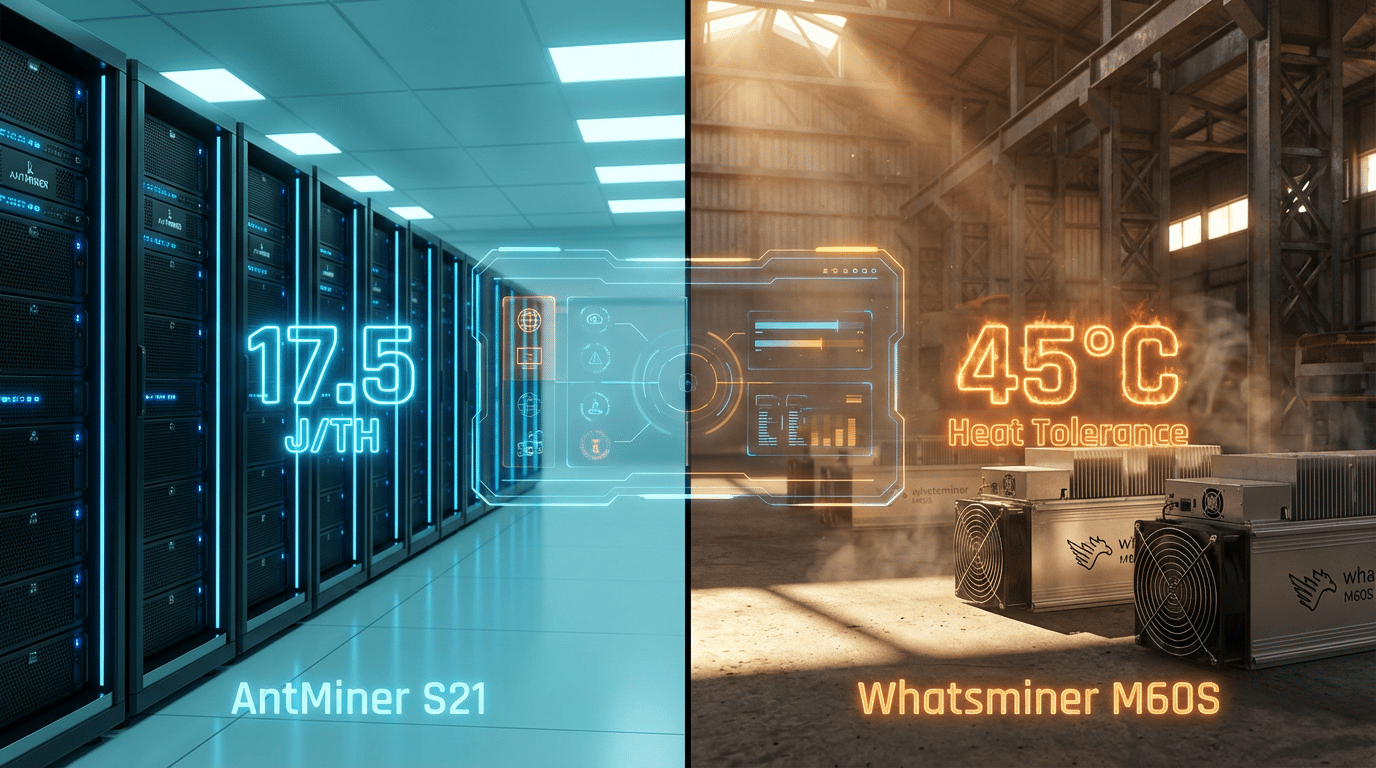
When comparing the Antminer S21 vs Whatsminer M60S for professional Bitcoin mining operations in 2026, the choice fundamentally depends on your facility's climate and electricity costs. The Antminer S21 is the leader in raw efficiency, delivering a massive 200 TH/s at an impressive 17.5 J/TH, making it the superior choice for maximizing ROI in controlled, cooler environments. In contrast, the Whatsminer M60S (typically 170-186 TH/s) is engineered for rugged stability, capable of operating in ambient temperatures up to 45°C where the S21 would throttle or shut down, making MicroBT's contender the undisputed king of reliability for hot climates and unstable grids.
The Landscape of Bitcoin Mining in 2026
As we navigate the post-halving landscape of 2026, the margin for error in Bitcoin mining has narrowed significantly. The days of simply plugging in the machine with the highest hashrate number are over. Today, operational expenditure (OpEx), specifically electricity costs and hardware depreciation, dictates profitability. Miners are no longer just competing against the network difficulty; they are competing against their own infrastructure's limitations. In this high-stakes environment, selecting the right ASIC hardware is not just a technical decision—it is a financial survival strategy.
The Conflict: Efficiency vs. Environmental Resilience
The core conflict facing US buyers today is the trade-off between peak efficiency and operational ruggedness. On paper, everyone wants the lowest Joules per Terahash (J/TH). Lower energy consumption means keeping more Bitcoin when the market is volatile. However, laboratory specs do not always translate to real-world mining farm conditions. A machine that saves you 5% on electricity but shuts down for four hours every afternoon during a Texas summer will lose far more revenue than it saves. This brings us to the pivotal question every farm operator must answer.
Question: Is Raw Spec Dominance Worth the Stability Risk?
Should you invest in the Bitmain Antminer S21, which promises the fastest payback period on paper due to its class-leading efficiency, or should you opt for the MicroBT Whatsminer M60S, which offers slightly lower peak performance but guarantees higher uptime in harsh conditions? To answer this, we must dissect the technical reality of Antminer S21 vs Whatsminer M60S.
Detailed Answer: Technical Comparison and ROI Analysis
Hashrate and Power Efficiency Metrics
In the battle of pure specifications, the Antminer S21 holds a distinct advantage. With a standard advertised hashrate of 200 TH/s, it acts as a powerhouse for facilities that can support its density. Its efficiency rating of 17.5 J/TH sets a high bar for the industry. For a miner paying $0.07 per kWh, this efficiency edge can mean the difference between profitability and breaking even during bearish market cycles.
Conversely, the Whatsminer M60S typically delivers between 170 TH/s and 186 TH/s, depending on the specific batch and model variant. Its standard power efficiency sits around 18.5 J/TH. While this appears less efficient than the S21, real-world testing reveals a nuance. The M60S features a 'Low Power Mode' manageable via its web GUI, which allows users to underclock the machine to achieve efficiency levels closer to 17-18 J/TH. This flexibility allows the M60S to compete closely with the S21 when tuned correctly, though the S21 wins on 'out-of-the-box' specs.
Thermal Management: The Critical Differentiator
This is where the comparison diverges sharply. Thermal management is often the deciding factor for farms in the southern United States. Independent stress tests and 'sauna tests' have revealed that the Antminer S21 is sensitive to heat. When ambient temperatures reach approximately 37°C to 38°C, the S21 tends to throttle or shut down completely to protect its chips. This makes it a risky investment for non-climate-controlled containers in hot regions.
The Whatsminer M60S, however, justifies its reputation for durability. Thanks to larger heat sinks—measured at approximately 310 square millimeters compared to the S21's 270 square millimeters—the M60S dissipates heat far more effectively. It can continue hashing at full capacity in ambient temperatures up to 45°C. For a mining operation in West Texas or Arizona, this heat tolerance translates directly to higher uptime and, consequently, higher total Bitcoin production over the machine's lifespan.
Physical Form Factor and Infrastructure Compatibility
When planning your rack space, physical dimensions matter. The Antminer S21 is physically larger than its MicroBT counterpart, occupying more volume in the rack. This results in a lower nominal power density per square foot, which can be a drawback for facilities with limited physical space but ample power capacity. Additionally, buyers should note the cabling requirements. The S21 series has seen variations in power connectors, sometimes requiring specific P13 or flat cables, whereas the M60S adheres to standard robust industrial power connectivity. Both machines operate on the standard 220V-240V infrastructure required for industrial mining.
Noise Levels and Maintenance
For home miners or facilities near residential zones, noise is a factor. Both air-cooled units are loud, rated around 75dB. While the S21 has an advertised lower noise floor for its hydro models, the standard air-cooled units are comparable to the M60S. However, in terms of maintenance, the M60S is often praised for its simplicity and the 'tank-like' build quality that resists dust and vibration better than the more delicate S21.
Summary: Which Miner Wins in 2026?
In my subjective view, the winner of the Antminer S21 vs Whatsminer M60S battle is entirely situational. If you are operating a sophisticated data center with excellent airflow management, evaporative cooling walls, or a location in a cooler climate like the Pacific Northwest, the Antminer S21 is the superior financial choice. Its 17.5 J/TH efficiency will squeeze every drop of profit out of your power contract.
However, if your mining farm is located in a hot climate, has variable airflow, or if you simply prefer a 'set it and forget it' operation that requires less babying, the Whatsminer M60S is the better long-term investment. The slightly lower efficiency on paper is negligible compared to the revenue lost if your S21s are offline due to overheating. In 2026, reliability is a form of efficiency, and for many, the rugged nature of the M60S offers a peace of mind that the S21 cannot match.
FAQs
What are the primary performance differences between the Antminer S21 and the Whatsminer M60S?
The Antminer S21 is the leader in raw specifications, offering a standard hashrate of 200 TH/s. In comparison, the Whatsminer M60S typically delivers between 170 TH/s and 186 TH/s depending on the specific model variant.
Which miner offers better energy efficiency?
The Antminer S21 offers superior 'out-of-the-box' efficiency at 17.5 J/TH. The Whatsminer M60S has a standard efficiency of roughly 18.5 J/TH, though it can be tuned via 'Low Power Mode' to achieve efficiency levels closer to 17-18 J/TH.
How do the thermal capabilities of the two miners differ?
Thermal management is a critical differentiator:
- Whatsminer M60S: Features larger heat sinks and can operate at full capacity in ambient temperatures up to 45°C.
- Antminer S21: Is more sensitive to heat, often throttling or shutting down when temperatures reach approximately 37°C to 38°C.
Why might a mining operation choose the Whatsminer M60S despite lower raw specs?
Operators choose the M60S for reliability and uptime in harsh conditions. While the S21 saves more power on paper, the M60S prevents revenue loss associated with downtime caused by overheating in hot climates or less controlled environments.
What are the ideal deployment scenarios for each miner?
The choice depends on the facility environment: